
Buying Property in Setenil de las Bodegas: The Cave Village That's a Real Place to Live
Spain's iconic rock-overhang village isn't just a postcard. Here's what living, owning, and renovating in Setenil actually looks like — including the renovation rules that catch most foreign buyers off guard.
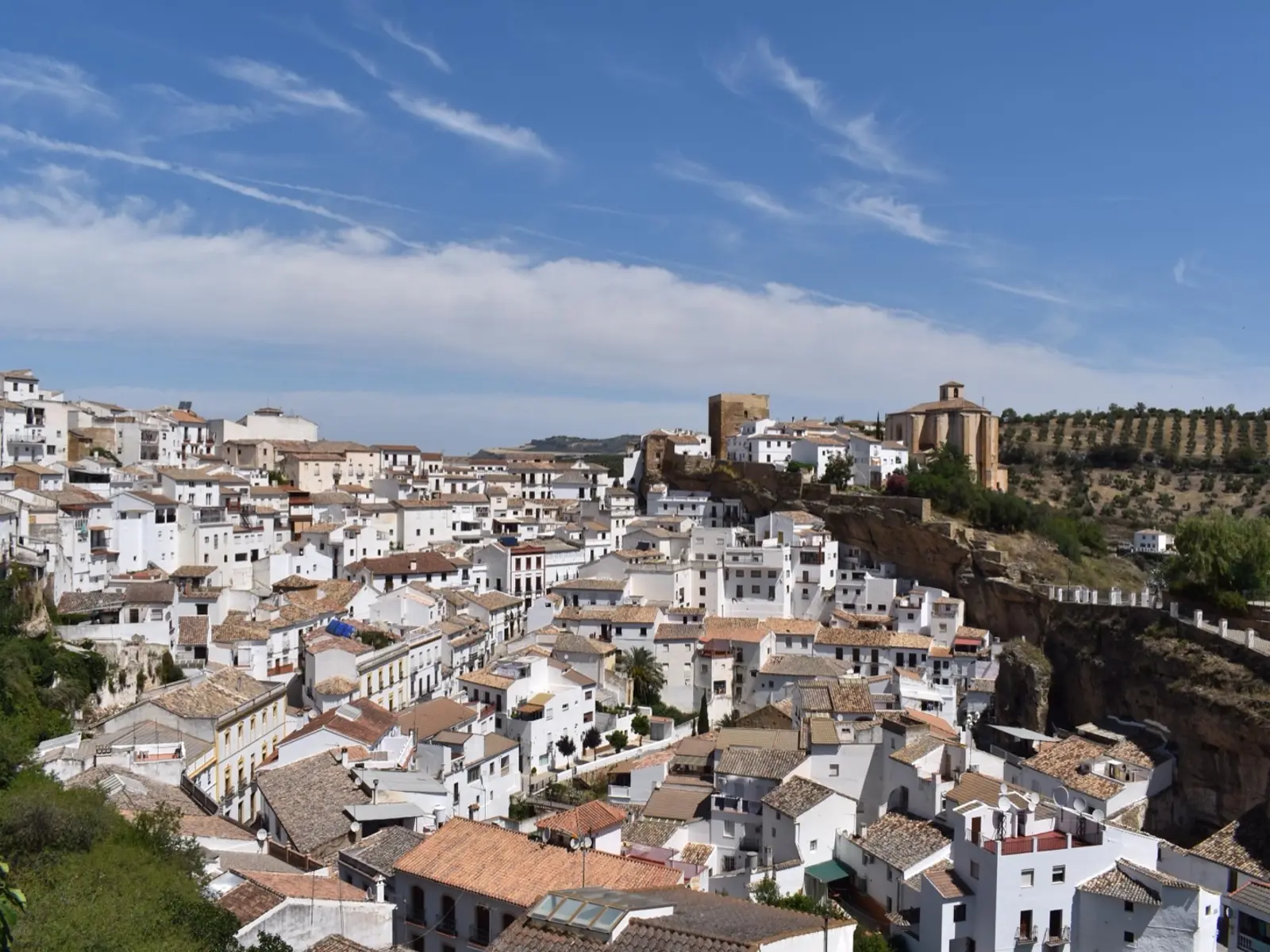
Setenil de las Bodegas is the village every photographer on the Costa del Sol eventually drives inland for. The white-painted houses tucked under a single overhanging sandstone slab make it onto half the postcards of Andalucía. What the postcards don't show is the rest of the village — a working pueblo of 2,800 residents with a primary school, a Tuesday market, and a property market that's quietly become interesting for the right kind of buyer.
Setenil as a place to actually live
The cave-house image is real, but it's only a few streets. The bulk of Setenil is a conventional Andalusian pueblo blanco built into a winding gorge, about 18 km north of Ronda. It sits at 640 metres of elevation, which means real winters with cold mornings and occasional frost, hot but bearable summers (lower humidity than the coast), two and a half hours from Málaga airport, and forty-five minutes from Ronda. Year-round amenities cover the basics: a primary school, two pharmacies, a health centre, four supermarkets (the largest is the Día on the edge of town), and a Tuesday weekly market. There is no international school within commuting distance — for school-age children, this is a school-in-Ronda or remote-schooling proposition.
Where the cave myth meets reality
Three broad categories of stock change hands here. The first is the cave houses — casas-cueva — built under or carved into the rock overhang. There are maybe 80 to 100 of these in total across two streets, Cuevas del Sol and Cuevas de la Sombra. Most are restored or partially restored, and habitable stock sits between 185,000 and 380,000 euros, with fully-renovated turn-key examples commanding more. The second category is conventional village houses: multi-storey townhouses set into the hillside, often with a roof terrace and partial views. This is the bulk of the market and runs from roughly 85,000 to 220,000 euros depending on condition, size, and view. The third category is ruins for restoration — semi-derelict properties suitable for full renovation. There are dozens of these on the market at any given time, priced between 35,000 and 95,000 euros for the property itself. Budget one and a half to two times the purchase price for the restoration work.
The renovation rules nobody tells you about (until they tell you)
Setenil's historic core is a Bien de Interés Cultural — Spain's top-tier heritage protection — and that carries real consequences. Any work that affects the exterior (façade colour, roof tiles, window frames, even satellite dish placement) needs explicit approval from the Junta de Andalucía's Cultural Heritage office, not just the town hall. Cave houses cannot be structurally altered in ways that affect the rock overhang or the historic frontage. You can modernise inside — plumbing, electrics, kitchens, bathrooms — but you cannot widen a window or carve deeper into the rock. Permits take four to eight months on average. Local builders know the process; your first phone call should be to an arquitecto técnico who has worked in the historic core before. Budget for this. A restoration that would cost 60,000 euros in an unprotected village can run 100,000 euros or more in Setenil's core, because of the time, materials, and specialist labour the heritage rules require.
Holiday rental versus year-round living
Setenil's tourist economy is heavily concentrated on day-trippers from Ronda and Málaga, and that changes the rental maths. Short-let demand on Airbnb and Booking is strong from April to October, especially for the cave houses; off-season occupancy drops sharply. Owners we've spoken to report 60 to 70 percent annualised occupancy for prime cave-house stock at 110 to 180 euros a night. The long-let market is thin: the expat population is small and most permanent residents own. If the plan is rental income, model conservative October-to-March numbers — that's where most pro formas go wrong.
Should you buy in Setenil?
Setenil is a great purchase for buyers who want a genuinely Spanish second home rather than a coastal expat compound — the pueblo speaks Spanish, votes locally, and operates on Spanish hours. It works for restoration-curious buyers with patience: there's still real opportunity here for someone who will take eighteen months to do a careful renovation. It works for short-let investors who model seasonality realistically — strong summer occupancy, weak winters, ~60 to 70 percent annualised on the prime cave stock. It's the wrong purchase for buyers who need a beach within walking distance, a daily British supermarket, or a frictionless renovation. For coastal stock instead, see our Estepona neighbourhood guide.
Browse current listings
See Setenil de las Bodegas properties currently for sale. The inventory turns over slowly, so it's worth setting an alert.